What "getting a website built" actually means in Canada
The phrase "build a website" hides an enormous range of deliverables. When a Canadian business hires a web designer, they are potentially purchasing any combination of: domain registration, web hosting setup, visual design (wireframes and mockups), HTML/CSS/JavaScript development, CMS configuration (typically WordPress), content entry, image sourcing and licensing, on-page SEO (title tags, meta descriptions, structured data markup), Google Analytics 4 and Google Search Console verification, post-launch cross-device testing, and ongoing maintenance. Which of those items is actually included varies enormously between freelancers, agencies, and DIY platforms — and most disputes between clients and web designers trace back to mismatched assumptions about scope, not malice or incompetence.
In the Canadian market, language requirements add a layer that many business owners in other countries don't face. Quebec businesses serving French-speaking customers need bilingual sites that comply with the requirements of the Office québécois de la langue française: French text must be at least as prominent as English, and user-facing elements (navigation, forms, CTAs, error messages) must be available in French. A freelancer in Montréal who quotes for a unilingual build is giving you a number that will be 20–40% too low if you actually need bilingual execution. Confirm language scope before comparing quotes.
PIPEDA — Canada's federal private sector privacy law — applies to any website that collects personal information through contact forms, newsletter sign-ups, e-commerce checkout, or booking systems. Quebec's Law 25 (effective in full since September 2023) adds provincial requirements including mandatory privacy impact assessments for significant personal data collection, explicit consent language, and a designated privacy officer for businesses of a certain scale. Agencies serving regulated sectors (healthcare, legal, financial services) typically build PIPEDA and Law 25 compliance into their standard discovery process. Most freelancers do not, unless you ask explicitly and confirm it in writing. Know what your compliance obligations are before you collect a single quote — it affects scope and cost on every path.
Understanding the full scope of what you need before collecting quotes is the single most effective step you can take to get comparable proposals and avoid mid-project invoice surprises. The brief checklist later in this guide covers the essential items to have ready.
The three paths: freelancer, agency, and DIY builder
Every Canadian business choosing a web design path is selecting from three models, each with a fundamentally different cost structure, risk profile, timeline, and quality ceiling.
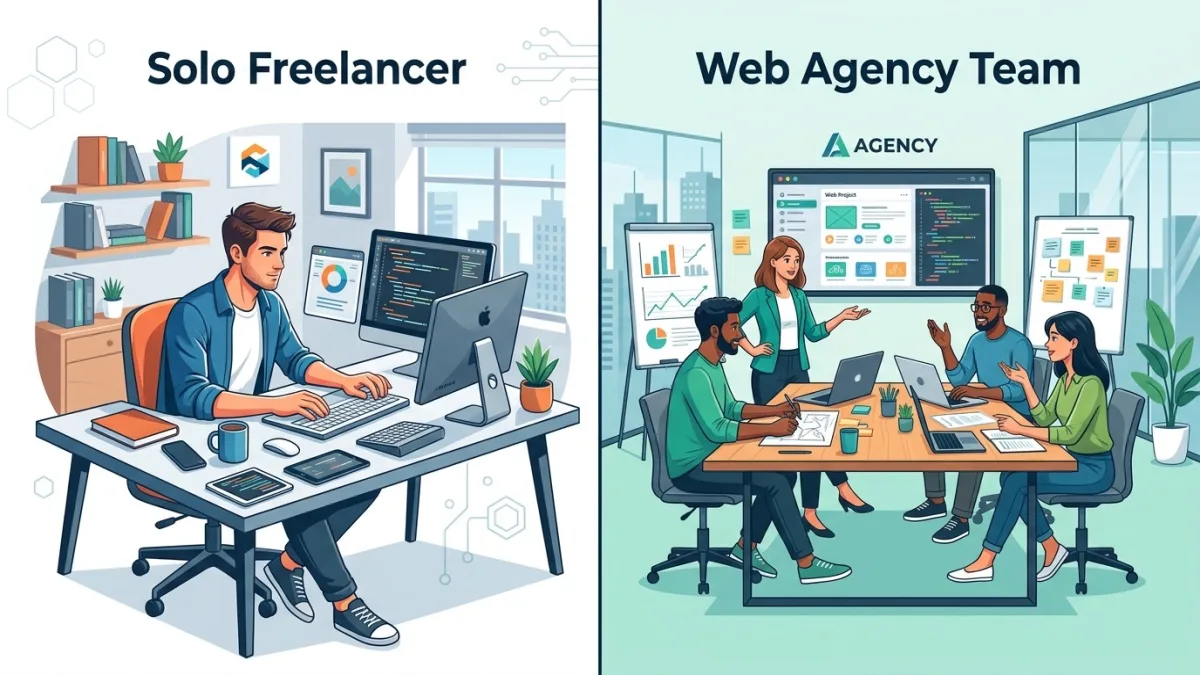
Freelancers are independent designers or developers working solo or with a small network of trusted subcontractors. They carry lower overhead than agencies — no downtown office lease, no account manager salary, no sales team or legal department — and pass those savings to clients in the form of lower project fees. The Canadian freelance market for web design is large and varies wildly in quality: experienced designers with 10+ years of WordPress, UX, and conversion rate optimization experience coexist with recent graduates quoting aggressively to build their portfolios. The gap in output quality between a skilled senior freelancer and an inexperienced junior is enormous, and quoted price alone does not tell you which category a freelancer falls into.
Agencies are businesses staffed by multiple specialized roles: UX/UI designers, front-end and back-end developers, SEO specialists, copywriters, account managers, and project managers. Their cost structure requires billing at rates that support those salaries, tools, benefits, and organizational overhead. The trade-off is systematic quality control, documented processes, clear contractual obligations, consistent post-launch support capability, and integrated service offerings that a solo operator cannot match at scale. The Canadian agency market ranges from boutique shops with two to five specialists to full-service digital firms billing hundreds of thousands per month.
DIY website builders — Squarespace, Wix, WordPress.com, Shopify, Webflow — provide templated platforms where a business owner designs and manages their own site. The financial cost is low ($240–$900 CAD/year for most plans). The hidden cost is time: building a functional, professional-quality site from a template typically takes 40–120 hours for someone without design experience, and all ongoing maintenance responsibility falls on the owner or a hired virtual assistant.
Most Canadian businesses eventually move through all three stages: DIY to prove concept, freelancer to professionalize, agency when scale demands full-service marketing. The recurring mistake is staying in the wrong stage too long — either DIYing past the point where a $2,500 freelancer site would have paid for itself in new leads within 90 days, or hiring a $40,000 agency for a site that an experienced $6,000 freelancer could have delivered with equivalent outcomes.
Freelance web designers in Canada: what you actually get
A skilled Canadian freelance web designer typically delivers: custom or semi-custom WordPress (or occasionally Webflow or Framer) site design and development, responsive mobile layout, basic on-page SEO setup, contact form configuration, Google Analytics 4 integration, and a defined number of post-launch revision rounds. Most experienced freelancers operating in the Canadian market work on fixed-fee contracts for defined scope, with hourly rates available for ongoing maintenance or change-order work.
Canadian freelance web design rates as of 2026 range from $45–$65/hour for junior designers (under three years of experience, often using fully templated approaches with limited custom design) to $90–$150/hour for senior designers with seven or more years of experience, conversion-focused portfolios, and deep sector knowledge in industries like legal, healthcare, or e-commerce. Fixed project fees for a standard 5–8 page small business site run $1,800–$7,500 depending on complexity, custom design scope, and whether copywriting is included. E-commerce projects typically start at $4,500 and run to $18,000+ depending on catalog size and integration requirements.
What freelancers typically do not include unless explicitly negotiated: professional photography or image licensing, copywriting, multilingual site versions, advanced e-commerce configuration beyond basic WooCommerce, ongoing SEO management, paid media management, and post-launch hosting management. If your project requires any of these, either retain specialists for each service or evaluate an agency that bundles them into a single engagement.
The accountability structure with a freelancer is personal and direct — you deal with one person who is responsible for all outcomes. This is efficient when the relationship works and fragile when it doesn't. Illness, capacity overcommitment, or a personality clash can stall your project with no internal escalation path. Structuring the contract carefully (see the Red Flags section below) is your primary protection. Require a milestone payment schedule, written scope, IP assignment language, and source code/credential delivery at project close as non-negotiable contract terms.
Freelancers are strongest for: businesses with a clear brief and well-defined scope, projects where launch speed and cost efficiency outweigh risk mitigation, owners who want direct communication without account-manager filtering layers, and situations where the owner's own editorial input can substitute for a professional content strategy.
Web design agencies in Canada: what the overhead buys you
Hiring an agency means hiring a system, not a person. The agency's overhead — designer and developer salaries, office space, project management tools, QA infrastructure, legal and accounting — is reflected in rates that typically start at $100–$175/hour for a boutique Canadian shop and $200–$400/hour for an established full-service agency in Toronto or Vancouver. Small business website projects at agencies range from $6,000 to $25,000; mid-market and e-commerce projects run $20,000 to $80,000 and above. Those numbers reflect real costs, not inflated margins.
What you gain at an agency that a solo freelancer cannot reliably replicate at scale:
- Structured discovery: agencies run formal discovery workshops to define site goals, user personas, competitor benchmarks, technical requirements, and content strategy before any design begins. This process reduces revision cycles and scope disputes — two of the most expensive events in any web project.
- Role specialization: the person designing your mockups is not the same person writing your copy or building your checkout flow. Specialists in each lane produce better output than a generalist stretched across all of them simultaneously.
- QA protocols: established agencies test across browsers (Chrome, Safari, Firefox, Edge), operating systems, device types (iOS, Android, desktop), screen sizes, and connection speeds before handoff. This catches rendering bugs and performance issues that a solo freelancer checking on their own machine will miss.
- Contractual precision: agencies have legal counsel or retain lawyers, so their contracts specify deliverables, timelines, IP ownership, revision rounds, payment milestones, and post-launch support SLAs with a level of precision that protects both parties from dispute.
- Organizational continuity: if your account manager leaves, the agency absorbs that transition. With a freelancer, losing the person means losing the project's institutional knowledge — files, credentials, context — unless you have managed the relationship carefully.
- Integrated marketing capability: agencies with in-house SEO, paid media, and content marketing teams allow you to continue the relationship post-launch without sourcing and onboarding additional specialists. This continuity is valuable when your web presence is a live marketing tool rather than a static brochure.
Agencies are strongest for: projects above $15,000 CAD, businesses that need bundled services (design + copywriting + SEO + paid media), organizations requiring post-launch SLAs with defined response times, and enterprise or regulated-sector clients where accountability documentation and compliance review are embedded requirements.
DIY website builders: when building it yourself actually makes sense
Squarespace, Wix, WordPress.com, and Shopify are legitimate business tools, not just cheap shortcuts that serious businesses outgrow automatically. For the right business profile, DIY is the economically correct answer. Squarespace's Business plan runs $29–$49 CAD/month (billed annually) and includes hosting, SSL, mobile-optimized templates, basic e-commerce, and analytics. Wix's comparable tier is $25–$45 CAD/month. WordPress.com Business runs approximately $45 CAD/month and allows plugin installation. For a sole proprietor, freelancer, or early-stage startup validating a concept, $300–$600/year for a clean, functional web presence is a rational allocation of limited capital.
The hidden cost is time, and most business owners undercount it dramatically. Building a professional-looking site on Squarespace or Wix typically consumes 40–120 hours for someone without design experience: platform learning, template selection and customization, page creation, copy writing and editing, image preparation, mobile layout review, form setup, analytics integration, and the iterations that follow when the first version doesn't look right. At a conservative $50/hour economic value for a business owner's time, an 80-hour Squarespace build carries a $4,000 opportunity cost — comparable to hiring a junior freelancer who would deliver it faster and with fewer compromises.
The SEO ceiling is the more critical long-term limitation. Standard DIY builder templates cannot compete for high-intent local search terms — "electrician Calgary," "divorce lawyer Toronto," "dental implants Vancouver" — without significant additional technical and content work that requires developer-level platform access most DIY plans restrict. Google's Core Web Vitals (Largest Contentful Paint, Cumulative Layout Shift, Interaction to Next Paint) are ranking signals as of 2024, and stock templates on Squarespace and Wix frequently score below the thresholds that competitive local searches require. See our website platform comparison for a detailed breakdown of SEO capability, technical flexibility, and e-commerce features by platform.
DIY wins when: your target audience finds you primarily through social media, referrals, or offline channels rather than organic search; your site is a portfolio or brochure where credibility signalling matters more than lead generation; you have genuine design and copywriting skills that translate to template customization; or you are at a validation stage where launch speed and capital preservation outweigh design quality.
Cost comparison: freelancer vs agency vs DIY in Canadian dollars
The table below reflects real market rates across Canadian cities in 2026. Ranges assume a standard small business site (5–10 pages, contact form, basic on-page SEO, no e-commerce) unless noted. Toronto and Vancouver rates typically run 10–20% above the national figures shown.
| Path | Entry price (CAD) | Typical range | E-commerce add-on | Monthly ongoing |
|---|---|---|---|---|
| DIY (Squarespace / Wix) | $0 setup | $240–$900/yr platform fee | Included or +$10–$25/mo | $20–$75/mo |
| Junior freelancer | $800 | $1,500–$4,500 | +$1,500–$4,000 | $0–$150/mo retainer |
| Senior freelancer | $3,000 | $4,500–$12,000 | +$3,000–$9,000 | $150–$600/mo retainer |
| Boutique agency (2–10 staff) | $6,000 | $8,000–$25,000 | +$5,000–$18,000 | $500–$2,500/mo retainer |
| Full-service agency (10+ staff) | $20,000 | $25,000–$80,000+ | +$15,000–$60,000+ | $2,000–$8,000/mo retainer |
A note on the "entry price" column: any quote below $800 for a professional Canadian business website is almost certainly a fully templated Squarespace or Wix delivery, a student practicum project, or a contractor operating from a jurisdiction where purchasing power parity makes Canadian prices unworkable for them. Overseas contractors are sometimes legitimate options, but verify time zone overlap with your business hours, English and French language fluency, and their familiarity with Canadian-specific requirements (AODA accessibility in Ontario, Law 25 in Quebec, PIPEDA federally) before committing. The enforcement risk sits with your business, not theirs.
For a deeper look at cost drivers including page count, CMS selection, and SEO scope, see our guide to web design pricing in Canada.
Timeline comparison: how long each path actually takes
Timeline misalignment is the second most common source of client-designer conflict, after scope disagreements. The figures below are realistic for a prepared client — meaning you arrive with your content, brand assets, and decision-making process organized before the project starts. Missing content is the single most common cause of overruns in every path.
| Path | Simple site (5 pages) | Standard site (10 pages) | E-commerce (50+ SKUs) | Primary bottleneck |
|---|---|---|---|---|
| DIY | 1–2 weeks | 2–5 weeks | 4–10 weeks | Owner availability |
| Junior freelancer | 2–4 weeks | 5–9 weeks | 9–18 weeks | Designer availability + content |
| Senior freelancer | 2–4 weeks | 4–8 weeks | 8–16 weeks | Content + client approval speed |
| Boutique agency | 4–7 weeks | 7–13 weeks | 12–22 weeks | Discovery + stakeholder approval |
| Full-service agency | 6–10 weeks | 10–18 weeks | 16–32 weeks | Process compliance + multi-round QA |
The content bottleneck is real and systematically underestimated. Industry project management research suggests 60–70% of web project delays are client-side: waiting for copy delivery, waiting for brand asset files, waiting for stakeholder sign-off, waiting for approval of the design mockup. If you want a fast launch, have your content prepared before the project starts. See the small business website checklist for the full pre-launch preparation sequence.
Risk and accountability: what happens when things go wrong
Risk management is where freelancers and agencies diverge most sharply — not in typical-day quality, but in what happens when something breaks, falls behind, or ends in dispute.
With a freelancer, you have a single point of failure. If your designer becomes seriously ill, takes on more clients than their schedule supports, or simply ceases communicating — a pattern documented in freelance forums across every industry — your project stalls with no internal escalation path. Your only recourse is whatever your contract specifies and potentially small claims court. In Ontario you can file for claims up to $35,000; in British Columbia up to $35,000; in Quebec the Small Claims Division handles claims up to $15,000. Recovery through the courts is possible but typically takes 6–18 months. A well-drafted contract with milestone payments reduces exposure significantly: you should never be more than one milestone payment ahead of delivered work.
IP ownership is a critical and frequently overlooked risk. In Canada, copyright in a creative work belongs to the creator unless explicitly assigned in writing under the Copyright Act. A web designer who builds your site owns the code and visual design unless your contract includes a clause assigning all intellectual property to you upon full payment. Confirm this language is in your contract before work begins. Verbal agreements do not override the default rule.
Hosting and domain control is a related risk. Some designers and agencies register your domain and hosting accounts in their own name — either out of convenience or as leverage to ensure continued payment for maintenance services. This is an unacceptable arrangement for any business asset. Your domain is a long-term digital property. Insist that your domain be registered in your business's name with your email address as the account owner, and that hosting credentials are delivered to you formally at project close. If a designer refuses this condition, that refusal alone is sufficient reason to choose someone else.
Agencies carry lower risk of project abandonment — they have organizational continuity that a solo freelancer does not — but they carry higher contractual complexity risk. Agency contracts typically include provisions for additional billing when scope expands beyond what was defined in the statement of work. Understanding what qualifies as "in scope" versus a billable change order is essential reading before signing. Request the agency's change-order policy and hourly rate card before the project starts. Understand whether revision rounds are capped and what happens when you exceed them.
Data privacy liability applies equally across all three paths. Under PIPEDA — and under Quebec's Law 25 for businesses with operations in Quebec — your business is responsible for personal information collected through your website regardless of who built the site. If a freelancer installs a contact form plugin that logs submissions to a US server without required consent language, your business bears the regulatory exposure. Verify data collection flows, consent mechanisms, storage jurisdiction, and privacy policy language with whoever builds your site. The Office of the Privacy Commissioner of Canada (priv.gc.ca) and Quebec's Commission d'accès à l'information both publish compliance checklists for websites.
SEO and long-term growth: who builds for discoverability?
A website that no one finds is a brochure no one reads. SEO capability varies enormously across the three paths, and choosing the wrong one compounds: a site built without proper technical SEO foundations can take 6–12 months to recover after corrective work, during which time competitors consolidate positions you've ceded.
DIY builders vary significantly in their SEO ceiling. Squarespace 7.1 provides solid core tools — custom title tags, meta descriptions, basic sitemap generation, product schema for e-commerce — but limited technical flexibility for structured data customization, canonical URL management, and Core Web Vitals optimization. Wix has improved its SEO infrastructure considerably since 2021 but still lags custom-built WordPress installations on structured data richness and server response times. WordPress.com restricts the plugin access essential for comprehensive SEO until you reach the Business tier at $45 CAD/month, and even then, some performance optimization plugins operate differently in the WordPress.com hosting environment than in self-hosted WordPress.
Freelancers who specialize in WordPress typically deliver: keyword-researched title tags and meta descriptions for each page, XML sitemap generation and submission to Google Search Console, Google Analytics 4 integration, and a correctly configured robots.txt. What they frequently do not deliver without explicit negotiation: Local Business JSON-LD schema markup, FAQ schema, BreadcrumbList schema, Core Web Vitals optimization beyond basic image compression, internal linking architecture, and on-page content optimization for target keywords. These omissions are the functional difference between a site that ranks on page one for "HVAC repair Ottawa" and one that sits on page four.
Agencies with in-house SEO teams build the full technical foundation into standard deliverables: complete structured data implementation, page speed optimization to Core Web Vitals thresholds, canonical tags, hreflang for bilingual sites, sitemap architecture, and internal linking strategy. For a Canadian business targeting keywords where organic search directly drives revenue, an agency with integrated SEO capability can justify its premium within six to twelve months of launch through measurable traffic and lead growth. See our local SEO guide for the technical checklist your site needs regardless of who builds it.
When a freelancer is the right answer
A freelancer is the economically correct choice when your project meets most of these criteria:
- Total budget is $2,000–$10,000 and you need a professional result without agency overhead embedded in the fee
- Your site is primarily a showcase or lead-generation tool, not a complex application or enterprise e-commerce platform with sophisticated integration requirements
- You have a clear brief: you know your brand positioning, can supply copy and images, and do not need discovery workshops to define what the site should communicate
- You are comfortable working directly with one person and can escalate concerns through direct conversation rather than through an account manager layer
- Your timeline target is 4–10 weeks and you can be a responsive client — providing approvals and content within 48–72 hours of requests
- Ongoing needs after launch are limited: basic plugin updates, minor content edits, and occasional design tweaks that a part-time maintenance retainer ($100–$400/month) can cover
The Canadian freelance web design market has genuine depth. Designers with 8–12 years of independent practice have verifiable track records through portfolio review, client references, and professional history you can examine. The key is vetting carefully rather than defaulting to the lowest quote. Three portfolio site references you can actually visit, two client phone references you can actually call, and a clear written contract are the minimum verification standard for any freelancer engagement above $2,000.
Businesses that consistently get strong results from freelancers include: local trades (plumbers, electricians, HVAC technicians, landscapers), food and hospitality operators, professional services providers (accountants, mortgage brokers, coaches, physiotherapists), and regional e-commerce businesses with defined product catalogs and manageable SKU counts. These categories have well-understood site structures, manageable scope, and success metrics (phone calls, booking form completions, direction requests) that an experienced freelancer can optimize for effectively.
When an agency is the right answer
An agency delivers its best value-to-cost ratio when your project crosses one or more of these thresholds:
- Budget exceeds $15,000 CAD, where systematic quality control, multi-role specialization, and formal QA protocols start to pay for themselves in reduced revision cycles and post-launch issues
- The project requires coordination across multiple service lines: web design, copywriting, brand identity, SEO strategy, paid media, and marketing automation all need to connect coherently
- You need contractual SLAs: a documented post-launch bug-fix guarantee within defined business hours, a formal escalation process, or audit trails for compliance documentation in regulated industries
- Your organization has multiple internal stakeholders — partners, a board, an in-house marketing team — whose approval cycles require a dedicated project manager to coordinate without stalling progress
- You are building a large-scale e-commerce operation, a platform with complex third-party integrations (ERP, CRM, inventory management, booking systems), or a site that requires custom application development beyond CMS configuration
- Your brand requires a complete design system — typography scale, colour system, icon library, component specifications — that a solo designer cannot produce efficiently within a competitive project timeline
Boutique Canadian agencies with five to fifteen staff represent the sweet spot for SMB clients in this tier: large enough to have role specialization and documented QA processes, small enough that agency principals remain accessible and the client relationship stays personal rather than disappearing into a queue. Be cautious of agencies whose pitch prominently features their Fortune 500 client roster if your budget is $20,000 — their minimum viable engagement size may be above yours, and you risk being a low-priority account handled by their most junior team members.
When DIY actually wins
The case for DIY is narrower than the marketing of Squarespace and Wix implies, but it is real in specific situations:
- You are a sole proprietor testing a business idea and need a professional web presence in days rather than weeks, with minimal capital outlay while the model is unproven
- Your primary customer acquisition channel is social media, referrals, trade shows, or other offline sources — your website functions as a credibility signal and contact page rather than an organic search lead generator
- You have genuine design skills or prior experience with the specific platform, and can produce output that looks considered rather than template-default
- Your total available budget is under $1,200 and a freelancer's minimum project fee exceeds what you can allocate at your current stage
- Your business category has lower visual standards: event landing pages, pop-up concepts, seasonal operations, creative portfolios where the work speaks for itself over the site design
A staged approach that works well for Canadian businesses at early stages: use Shopify or Squarespace to launch and validate revenue potential, then commission a freelancer to rebuild the site on WordPress or a custom Shopify theme once sustained revenue justifies the investment. This sequence avoids the risk of spending $5,000–$8,000 on a professional build for a business model that may pivot significantly in year one.
Red flags when hiring a web designer or agency
The Canadian market has designers and agencies who deliver excellent, accountable work — and operators who will cost you money, time, and search rankings. These eight red flags apply equally to freelancers and agencies and help you filter early in the evaluation process:
- No written contract. Any professional charging more than $500 for web work should provide a written contract specifying scope, timeline, payment milestone schedule, included revision rounds, IP ownership assignment, and post-launch support terms. A designer who operates on verbal agreements or email threads is exposing you to disputes that have no documentation to resolve them.
- 100% upfront payment required before work begins. Industry standard for web projects is a deposit (25–50%) at contract signing, a milestone payment at design mockup approval, and final balance at site launch or client sign-off. Requests for full payment upfront — particularly from designers you cannot verify through established portfolios or live references — are a significant red flag.
- Portfolio links that 404 or show only template demos. Always click every portfolio URL before hiring. Template showcase links that were never deployed for a paying client, or site links that have gone offline since the project, are signs of an inflated or fabricated portfolio. Ask for the names and contact information of clients at those URLs and call them.
- Vague or absent timeline commitments. "I'll have it done soon" is not a project plan. Any serious freelancer or agency should provide a phased timeline with dates: content-due deadline, design mockup delivery, client feedback window, development completion, QA and testing, launch date. Vague timelines protect the designer's flexibility at your expense.
- Domain or hosting registered in the designer's name. Your domain is a business asset that accumulates authority, backlinks, and search history over time. If it is registered in a designer's account, they control a critical business asset. Insist on domain registration in your business's name, or a formal transfer to your ownership at project close. Non-negotiable.
- No discussion of mobile optimization or page speed. Google's mobile-first indexing has been the default since 2019. A designer who does not proactively raise mobile layout, Core Web Vitals, and responsive design as standard deliverables is either inexperienced or not thinking about your business outcomes beyond the visual handoff.
- High-pressure closing tactics. "I can only hold this rate for 48 hours" or "I have another client lined up for this slot" are sales pressure techniques common in low-quality vendor interactions. A confident designer with a strong book of work has no reason to rush your decision. Take the time to review proposals carefully, check references, and compare scope before committing.
- No mention of analytics, Search Console, or post-launch support. A website is not finished at launch — it requires monitoring, performance tracking, plugin and security updates, and ongoing optimization. A designer who presents go-live as the end of their responsibility, with no discussion of what happens next, is not aligned with your business outcome. Even a minimal post-launch plan (Search Console verification, Analytics 4 event configuration, update schedule) signals that the designer thinks about your site as a living tool, not a deliverable to collect payment on.
Canadian SMB case study: three businesses, three different decisions
These examples are anonymized composites of decision patterns that play out regularly across Canadian markets.
Case 1: Edmonton home services (plumbing, $2,000 budget). A one-person plumbing operation in south Edmonton needed to replace a 2019 site built on a free platform. The owner had limited capital, a clear brief (five pages: home, services, service area, reviews, contact), existing photography, and a referral network that drove most current bookings. A junior freelancer was hired at $1,800 for a WordPress site with Google Maps integration and local SEO setup. The site launched in three weeks. Within 60 days it drove 14 new inbound calls via Google Maps proximity searches. For this client, the freelancer path was correct: the budget matched the scope, the owner had a clear brief, and the conversion target (phone calls from local search within a defined service area) was achievable without advanced SEO strategy or agency overhead.
Case 2: Toronto personal injury law firm ($23,000 budget). A boutique personal injury firm in downtown Toronto needed to compete for "car accident lawyer Toronto" — a high-competition keyword with significant paid search and organic presence from established firms. The firm engaged a boutique Toronto agency at $20,500 for a full site build, plus a $2,500/month SEO retainer. The agency's structured discovery phase uncovered that the firm's strongest differentiator was a 30-day case consultation guarantee that no competitor communicated clearly online — a fact the firm's previous site had never surfaced. The new site led with that guarantee, built attorney biography pages with Attorney schema markup, and integrated a secure intake form compliant with the Law Society of Ontario's digital communication guidelines. Within nine months, the firm ranked on page one for three competitive terms and reduced its paid search spend by 40% as organic leads increased. An experienced freelancer might have built an equivalent site for $8,000 — but without the discovery process, the compliance review, and the integrated SEO retainer, the outcome would have been materially different.
Case 3: Montréal gift retailer (validation stage). A Montréal gift shop owner needed to sell online during the holiday season with six weeks until peak demand. She built on Shopify's $39 CAD/month plan using a $240 USD purchased theme, spending approximately 25 hours on configuration. The site was live in 11 days. Revenue in the first season was $17,000 — enough to validate the channel. She subsequently hired a freelancer to rebuild on a custom Shopify theme at $4,200, adding bilingual French/English navigation and structured data for all products. For her, DIY was the correct first move: it validated demand at minimal cost before committing to a professional build. See our website examples by industry for category-specific patterns across retail, hospitality, and professional services.
Decision framework: 5 questions to find your path
Run through these five questions in sequence. The first question that produces a definitive answer is usually the correct filter — do not override it with post-rationalization:
- What is your hard budget? Under $1,200 CAD: DIY builder is the only realistic option. $1,200–$10,000: vetted freelancer range — junior for simpler sites, senior for complex or conversion-focused builds. $10,000–$25,000: senior freelancer or boutique agency, depending on integrated service needs. Above $25,000: agency with clear specialization in your sector or project type.
- How competitive is your target search market? If you need to rank on page one of Google for a term with meaningful monthly search volume in a Canadian city, you need a custom-built site with proper technical SEO architecture from day one. DIY builders will not reach that threshold without significant developer-level customization that eliminates most of the cost savings. If your primary acquisition channel is not organic search, the platform matters less than the quality of design and copy.
- How clearly defined is your scope? If you have a content brief, brand guidelines, a clear page list, and defined success metrics, a freelancer can execute efficiently without discovery overhead. If you need help defining what your site should be, what it should say, and who it is actually targeting, an agency's discovery process has real value — or engage a brand strategist first, then hire a freelancer to build what the strategy specifies.
- What do you need after launch? If you need ongoing SEO management, monthly blog content, performance reporting, and integrated paid media management, an agency that bundles these services reduces the coordination overhead of hiring, briefing, and managing separate specialists. If you need only plugin updates, security monitoring, and occasional content edits, a freelancer maintenance retainer ($100–$500/month) is more cost-effective than an agency retainer for equivalent work.
- How much project management capacity do you have? Every web project requires significant client input — content delivery, design approvals, feedback turnaround, stakeholder sign-off. If you are a single-person operation and cannot reliably respond to designer requests within 48 hours, add 30–50% to your timeline estimate in any path. Agencies have project managers who absorb some coordination load; freelancers need you to be a responsive client. DIY projects expand to fill exactly as much time as you give them, with no external accountability.
What to put in your web design brief before collecting quotes
The quality of the brief you provide is the single strongest predictor of quote comparability and project smoothness — regardless of who you hire. Collect all of the following before sending your first quote request:
- Business name, primary city of operation, industry category, target customer profile, and the one thing that differentiates your business from the most direct competitor
- Complete page list (e.g., Home, About, Services × 3, Blog, Contact) with any special features per page (booking widget, product gallery, video embed)
- Features required: contact form, online booking, e-commerce checkout, live chat integration, multilingual support, membership or login area, email newsletter opt-in
- Three competitor or reference sites you like, and a specific note about what you like about each — visual style, navigation structure, copy tone, a specific feature
- Existing brand assets: logo file (SVG or EPS preferred; PNG acceptable), brand colour hex codes, primary and secondary typefaces, existing photography, any existing brand guidelines document
- Content status: will you provide all copy, or does the designer or agency need to write it? Do you have professional photography, or do you need stock images sourced?
- Target launch date and the reason for it (marketing campaign, seasonal peak, conference, regulatory deadline)
- Honest budget range — qualified professionals adjust scope to fit a realistic budget rather than submitting inflated quotes; vague "let's discuss budget" framing usually results in over-engineered proposals that miss your real constraints
- Technical integration requirements: CRM (Salesforce, HubSpot, Zoho), booking platform (Calendly, Acuity, Jane App for healthcare), payment processor (Stripe, Square, PayBright for BNPL), or ERP connection
- Accessibility requirements: Ontario's AODA requires WCAG 2.0 Level AA compliance for private sector organizations with 20 or more employees; federal government suppliers must meet the Standard on Web Accessibility; universities and public sector entities have additional requirements
- Privacy and consent requirements: are you collecting personal information? Do you need PIPEDA consent language, a privacy policy, a cookie consent banner? Are you subject to Quebec's Law 25 enhanced requirements?
Common questions
Is a freelancer or agency better for a small business website in Canada?
For most Canadian small businesses spending under $8,000, a vetted freelancer with a strong portfolio in your industry delivers comparable quality at a lower cost than an agency. Agencies add consistent value on projects above $15,000, on multi-team builds, or where ongoing marketing retainer support is required alongside the initial build.
How much does a freelance web designer charge in Canada?
Canadian freelance web designers typically charge $50–$120/hour or quote fixed project fees ranging from $1,500 for a simple brochure site to $8,000–$15,000 for a custom multi-page build with SEO setup included. Rates are highest in Toronto and Vancouver, and roughly 10–20% lower in mid-sized markets like Halifax, Winnipeg, and Quebec City.
How long does it take a freelancer to build a website vs an agency?
A freelancer typically delivers a 5–8 page website in 3–6 weeks from content receipt. An agency runs 6–14 weeks for the same scope due to discovery phases, multiple stakeholders, and QA cycles. DIY on Squarespace or Wix can be done in days but requires 40–80 hours of your own time and trades search ranking ceiling for launch speed.
What are the biggest risks of hiring a freelance web designer?
The three biggest risks are: project abandonment if the freelancer takes on excessive commitments or faces a personal emergency; single point of failure for ongoing maintenance and institutional knowledge; and scope creep without a clear contract specifying what is and is not included. Mitigate all three by requiring a signed contract, a milestone payment schedule, and source code and hosting credential delivery in your name at project close.
What does a web design agency include that a freelancer doesn't?
Agencies typically include dedicated account management, multi-browser and multi-device QA testing, professional copywriting, structured project management, post-launch support SLAs with documented response times, and integrated service capability across SEO, paid media, and brand strategy. Most freelancers provide design and build only, with maintenance available as an optional separate retainer.
Can I use a DIY website builder for a Canadian business?
Yes — Squarespace, Wix, and Shopify are legitimate options for businesses whose customers find them through social media, referrals, or offline channels. The key limitation is SEO ceiling: DIY builder templates generally cannot compete for high-intent local search terms like "plumber Toronto" or "accountant Calgary" without significant technical work that most DIY plans restrict.
What should I look for in a web design contract in Canada?
Your contract must specify: IP ownership (copyright assigned to you upon full payment), source code delivery, hosting credentials in your business name, a milestone payment schedule (never 100% upfront), the number of included revision rounds, post-launch support scope and duration, and PIPEDA-compliant data handling for any personal information collected through the site.
What red flags should I watch for when hiring a web designer or agency?
Key red flags: no written contract, 100% payment required before work begins, portfolio links that 404 or show only template demos, vague timelines without milestone dates, domain or hosting registered in the designer's name rather than yours, no mention of mobile optimization or Core Web Vitals, and closing pressure to decide before you have reviewed a formal proposal or spoken to client references.
Not sure which path is right for your project?
Tell us your business, budget, and timeline. We will match you with the right approach — no cost, no obligation.