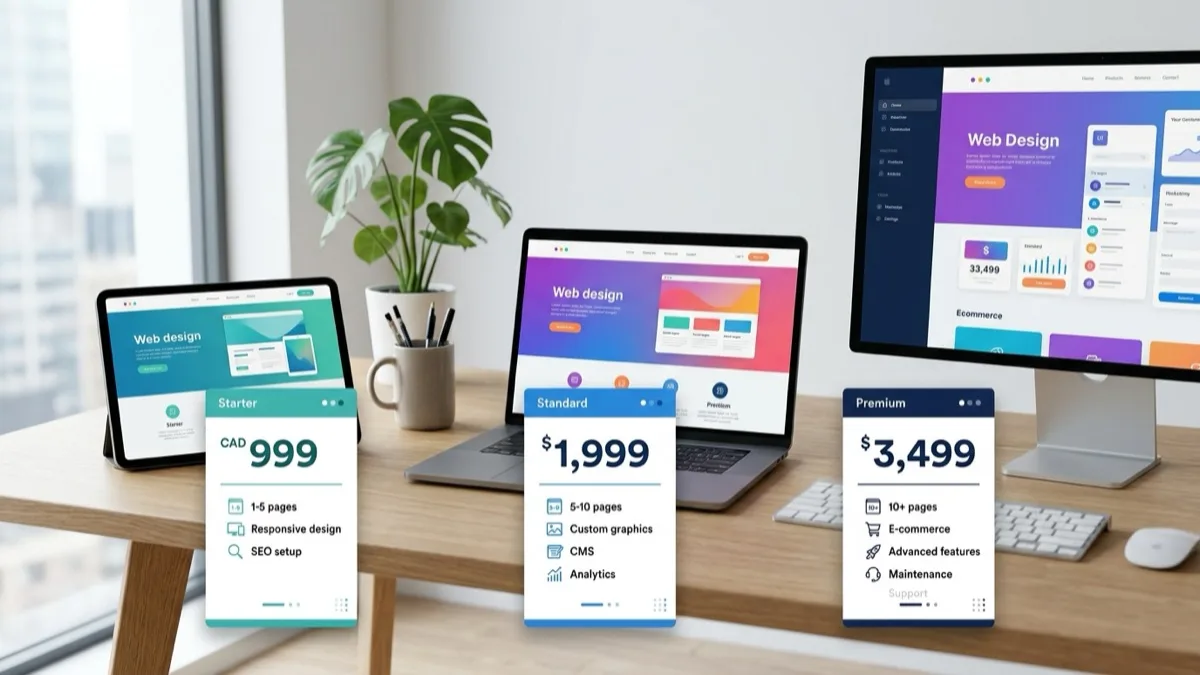
What "web design pricing" actually covers
Before comparing numbers, it helps to know what you are actually buying. Web design pricing is not a single line item — it bundles anywhere from two to a dozen deliverables depending on the provider and the scope of work.
At minimum, a web design project includes visual layout (how the site looks) and front-end development (how it is built and rendered in a browser). From there, scope typically expands to include information architecture (how the pages are organized), user experience design (how easy the site is to navigate), copywriting (who writes the words), search engine optimization (whether Google can find and rank the pages), and ongoing maintenance (who fixes things when they break).
The single biggest reason two web design quotes for "the same five-page site" can differ by CA$8,000 is that one quote bundles all of the above and the other covers only layout and development. When you see a suspiciously low quote, ask explicitly: Does this include copywriting? On-page SEO? Mobile QA on real devices? Post-launch support? The answers will explain the gap every time.
A second major variable is platform. A WordPress site built on a premium theme and a custom-coded Webflow or React site both fall under "web design," but the latter can cost three to five times more to build and substantially more to maintain. When comparing quotes, confirm which platform is proposed and whether you own the licence outright or are paying a recurring platform fee.
A third variable is geography. Rates in Toronto and Vancouver are generally 15–25% higher than in smaller markets like Regina, Saguenay, or Fredericton, reflecting local cost of living and market competition. Remote work has compressed this gap — a Moncton freelancer can serve a Toronto client at Moncton rates — but it still exists at the agency level, where local overhead is real and priced in.
The three ways web designers charge you
Canadian web designers and agencies bill in one of three ways: fixed project price, hourly rate, or monthly retainer. Each model carries a different risk profile and suits different project types.
Fixed project price — the most common model for new-build projects. The designer scopes the work, delivers a single number, and you pay that (usually 50% upfront, 50% on launch) regardless of actual hours. The risk is on the designer: if the project runs long, they absorb it. Your risk is scope creep — every "small change" you add mid-project can trigger a change order at CA$100–$175 per hour. Fixed pricing works well when you have a detailed brief and can commit to timely decisions throughout the project. Without a locked scope, fixed-price quotes are effectively fictional.
Hourly billing — common for smaller freelancers and for projects where scope is not yet defined. You pay for actual time tracked, usually invoiced weekly or monthly. This gives you maximum flexibility to change direction mid-project but removes budget certainty. Canadian freelance hourly rates run CA$60–$120/hour for generalists and CA$100–$180/hour for specialists in Figma UX, custom JavaScript, or headless CMS builds. Always ask for a time estimate in hours before starting — a capable designer can give a useful range even on ambiguous projects.
Monthly retainer — used for ongoing work after a site launches, or for continuous content updates and conversion optimization. A retainer reserves a set number of hours per month at a slightly discounted rate in exchange for commitment. Canadian web design retainers typically run CA$500–$2,500/month depending on hours, scope, and whether SEO or content creation is bundled. Retainers make sense once your site is live and generating consistent traffic that you want to convert. Avoid locking into a retainer before you have a clear picture of what monthly volume actually looks like in practice.
Freelancer vs. agency: the real trade-off
The freelancer vs. agency question is the most common dilemma Canadian businesses face when budgeting a web project. Here is what the price difference actually reflects — not marketing language, not assumptions.
A freelancer is one person, usually a designer who also does development or a developer who also does design. Their overhead is minimal — no office, no HR, no project managers — which is why they can charge less. A good Canadian freelancer with five years of experience can deliver a polished WordPress site for CA$2,500–$6,000. The trade-off is bandwidth: a solo operator is juggling multiple clients, may take days to respond during crunch periods, and has no backup if they fall sick or go on vacation mid-project.
An agency brings a team: a dedicated designer, a developer, an SEO lead, a project manager, and often a copywriter. Each person is specialized in their discipline. The overhead is real, which is why agency rates start at CA$5,000 for the simplest projects and scale quickly above that. What you get in return is a defined process, clear milestones, accountable project management, and continuity — if the lead designer leaves, the project continues. For projects above CA$10,000 that involve strategy, content, and ongoing support, this overhead usually earns its cost.
For most Canadian SMBs with a budget under CA$5,000, a vetted freelancer is the right call. For projects above CA$8,000 that need integrated strategy, a content-writing pass, and ongoing support SLAs, an agency is usually worth the premium. A useful middle ground exists in the CA$5,000–$10,000 range: a senior solo consultant who subcontracts specialists (a dedicated copywriter, a technical SEO, a UX designer) while staying your single point of contact and billing at a lower blended rate than a full agency.
Web design pricing by site type (CAD, 2026)
The table below shows build-cost ranges by site type for the Canadian market in 2026. These figures cover design and development only — they exclude domain registration, hosting, copywriting, photography, and ongoing maintenance unless noted.
| Site type | Freelancer | Agency | Timeline | Typical platform |
|---|---|---|---|---|
| Basic brochure (1–5 pages) | CA$1,200–$3,500 | CA$3,000–$7,000 | 2–5 weeks | WordPress, Squarespace |
| Professional business (6–15 pages) | CA$3,000–$7,000 | CA$6,000–$18,000 | 5–10 weeks | WordPress, Webflow |
| Single landing page | CA$800–$2,500 | CA$2,000–$5,000 | 1–3 weeks | WordPress, Webflow |
| Portfolio / creative | CA$1,500–$4,000 | CA$4,000–$10,000 | 3–6 weeks | Webflow, Squarespace |
| Ecommerce (small, under 200 SKUs) | CA$4,000–$9,000 | CA$8,000–$20,000 | 6–12 weeks | Shopify, WooCommerce |
| Ecommerce (large / custom) | CA$10,000–$25,000 | CA$20,000–$50,000+ | 12–24 weeks | Shopify Plus, custom |
| Web app / SaaS front-end | CA$12,000–$30,000 | CA$25,000–$100,000+ | 16–40 weeks | React, Next.js, Laravel |
| Website redesign | CA$2,000–$8,000 | CA$5,000–$20,000 | 4–12 weeks | Same or migration |
All figures are pre-tax. Canadian providers registered for GST/HST will add the applicable provincial rate — see the hidden costs section below. The "freelancer" column assumes a solo operator with three or more years of experience; a very junior freelancer can quote 30–40% below these ranges with results that reflect it.
What a CA$2,500 web design budget actually buys
At the CA$2,000–$3,500 tier, you are almost always working with a freelancer or a very junior agency. Here is what you can realistically expect — and what you cannot expect to receive at this price point.
What you get: A template-based website on WordPress, Squarespace, or Wix. Usually four to six pages — home, about, services, contact, and possibly a basic blog. Mobile responsiveness from the chosen theme, not from custom breakpoint engineering. One to two revision rounds on the homepage design. A contact form with email routing. Google Analytics 4 setup. A short handoff video or PDF guide showing you how to update content yourself.
What you do not get: Custom design — the site will look like the template, likely identical to dozens of other sites built on the same theme. Copywriting — you provide the text, and the designer places it. Professional photography — expect to use stock images. On-page SEO beyond basic title-tag and meta-description fields. Post-launch support beyond 14–30 days. Speed optimization or Core Web Vitals work.
This tier is entirely appropriate for a local tradesperson — plumber, electrician, landscaper, painter — who needs a credible online presence but is primarily converting customers through word of mouth and their Google Business Profile. Do not expect to rank competitively for high-value organic keywords on a CA$2,500 build. The on-page foundations simply will not support it without additional investment in content and SEO.
One honest word on DIY builders at this tier: if your time is worth more than CA$50/hour, building it yourself on Squarespace or Wix may cost more in productivity than hiring a junior freelancer for CA$2,000 and then self-managing content. The math depends entirely on how technical you are and how much opportunity cost your own time carries.
What a CA$5,000 web design budget actually buys
The CA$4,500–$7,000 range is the most common sweet spot for Canadian small businesses getting a serious web presence built. At this tier the quality gap over CA$2,500 is substantial and visible.
What you get: A custom-template or semi-custom WordPress or Webflow site with 8–15 pages. A unique homepage design — not a carbon copy of the same Elementor template used by your nearest competitor. Mobile QA on multiple real devices. On-page SEO: keyword-informed title tags and meta descriptions, proper H1/H2 heading structure, image alt text, and schema markup for the business type. A logical internal linking structure. A contact form with auto-reply and email routing. Google Analytics 4 and Google Search Console setup and initial configuration. 30–60 days of post-launch bug support.
What you still do not get: Bespoke UI/UX developed from a custom Figma prototype. Conversion rate strategy (heatmap analysis, A/B testing, funnel mapping). Copywriting beyond a light structural edit of your draft text. Ecommerce functionality. CRM integration, booking system connection (Jane, Calendly, Acuity), or payment gateway setup without change orders.
For professional services firms in Canadian cities — law offices, accounting firms, physiotherapy clinics, insurance brokers, financial advisers — this is typically the right tier. The site will be credible, fast, and SEO-ready without overspending on capabilities you will not use in year one of the new site. See the small-business website checklist to confirm your must-haves before writing the brief.
What a CA$10,000+ web design budget actually buys
Above CA$10,000 you are entering agency territory for most project types. The deliverables list changes substantially and the strategic value of the engagement increases as a result.
At CA$10,000–$20,000 you get: A fully custom design created from a Figma prototype — not adapted from a theme, designed specifically for your brand and audience. A proper discovery and UX phase: competitor analysis, user journey mapping, conversion goal definition. Professional copywriting for 8–12 pages. Advanced on-page SEO including schema markup (Service, LocalBusiness, FAQPage), an internal link strategy, and Core Web Vitals optimization (image compression, script deferral, font loading). Integration with a CRM, booking system, or payment gateway. A training session on the CMS after handoff. Typically 60–90 days post-launch support with a defined response SLA.
At CA$20,000–$50,000+ you get: Custom ecommerce platforms, web app front-ends, or enterprise-level redesigns. Multi-location or multi-language implementations — including English and French under Canadian federal bilingualism requirements for regulated sectors. Full API integrations with accounting software (QuickBooks CA, Sage), inventory management, or logistics providers. Accessibility audits and remediation against WCAG 2.1 AA, increasingly required for organizations subject to the Accessibility for Ontarians with Disabilities Act (AODA) or BC's Accessible BC Act. Dedicated QA, browser-stack testing, and load testing before launch.
At this tier, ask for the agency's project methodology (Agile vs. waterfall), their discovery process documentation, and at least two references from comparable Canadian projects in your vertical. The investment is large enough that twenty minutes of due diligence calls will pay for themselves many times over.
Freelancer vs. agency: side-by-side comparison
| Factor | Freelancer | Agency |
|---|---|---|
| Price (typical project) | CA$1,500–$8,000 | CA$5,000–$30,000+ |
| Speed to start | Days (lower queue) | 1–3 weeks (onboarding) |
| Design quality ceiling | High if experienced | Higher (specialized roles) |
| Strategic guidance | Varies widely | Usually included |
| Copywriting | Extra cost or DIY | Often bundled |
| SEO setup | Basic; extra cost for depth | Usually included |
| Project management | You coordinate | Dedicated PM |
| Post-launch support | 14–30 days, ad hoc | 60–90 days, defined SLA |
| Availability risk | Higher (single point of failure) | Lower (team redundancy) |
| Best for | Brochure, portfolio, budget builds | Ecommerce, lead gen, scale |
Hidden costs that blow Canadian web design budgets
The quoted price is rarely the total price. Here are the most common cost surprises Canadian businesses encounter after signing — and how to account for them before you commit.
- Domain registration: CA$15–$25/year. Your web designer may include it in the quote or charge it separately. Note that .ca domains must be registered by a Canadian Presence Requirements-eligible entity (per CIRA policy). CIRA-accredited registrars operating in Canada include GoDaddy CA, Namecheap CA, Tucows Domains (OpenSRS), and NameBright. Never let a designer register a domain in their own account — own the domain yourself.
- Web hosting: CA$5–$200/month. Budget CA$5–$25/month for basic shared hosting (fine for low-traffic brochure sites), CA$30–$80/month for managed WordPress hosting (WP Engine, Kinsta, Pressable), and CA$50–$200/month for dedicated or cloud hosting needed by ecommerce sites. Hosting is a recurring cost that continues whether you are actively working with a designer or not.
- Premium plugins and themes: CA$200–$800/year. A professional WordPress build may depend on Advanced Custom Fields Pro (CA$56/year), Gravity Forms (CA$59/year), WooCommerce extensions (CA$79–$299 each), or Elementor Pro (CA$67/year). These costs renew annually. Ask your designer for a complete plugin list before launch so recurring fees are not a surprise at renewal time.
- Copywriting: CA$150–$350 per page. Professional web copywriting in Canada runs CA$150–$350 per page plus HST. A 12-page site at CA$200/page adds CA$2,400 to the project before a layout is designed. Many businesses budget zero for copy, assume they will "write it themselves," and then stall for months waiting on their own content. The most reliable way to blow a web design budget is to let content delivery slide.
- Photography: CA$800–$2,500 for a half-day shoot. Stock images cost CA$15–$80 each (Adobe Stock, Shutterstock). A professional brand photoshoot in a Canadian city typically runs CA$800–$2,500 for a half day with 30–60 edited images. In competitive sectors — restaurants, real estate, healthcare, hospitality — authentic photography is the single highest-ROI investment you can make before a site launch. Stock imagery signals inauthenticity to visitors who have seen the same RF photo on six other sites.
- Taxes: 5–15% depending on province. Web design is a taxable supply under Canada's Excise Tax Act. GST at 5% applies in British Columbia, Alberta, Manitoba, Saskatchewan, and Quebec (Quebec also adds QST at 9.975%). HST applies at 13% in Ontario and 15% in Nova Scotia, New Brunswick, Prince Edward Island, and Newfoundland and Labrador. A CA$10,000 project in Ontario is CA$11,300 after tax; in Nova Scotia, CA$11,500. Always ask whether a quote is presented plus tax or inclusive of tax.
- Ongoing maintenance: CA$75–$250/month. WordPress sites require regular plugin and theme updates, security monitoring, database optimization, and offsite backups. If you are not handling this yourself, budget CA$75–$250/month for a website care plan. Neglecting maintenance is how Canadian SMBs end up with hacked sites serving pharma spam — a painful and expensive discovery, typically eight months after the compromise occurred.
- SSL certificate: free to CA$120/year. Most quality hosts include a free Let's Encrypt certificate. Some discount hosts advertise low monthly rates and then charge CA$60–$120/year for SSL as an add-on. Confirm SSL is included — a site without HTTPS in 2026 will trigger browser security warnings that destroy conversion rates.
How to evaluate a web design quote: a six-step process
When you receive a web design proposal, resist the instinct to evaluate on price alone. The cheapest quote often delivers the lowest value. Here is a disciplined process for comparing proposals side by side.
- Normalize the scope first. Before comparing any numbers, confirm each quote covers identical deliverables: same page count, same SEO scope, same copywriting responsibility, same post-launch support window. A CA$4,500 quote that includes copywriting and 60 days support may be better value than a CA$3,000 quote that includes neither. You are shopping for outcomes, not hours.
- Confirm platform ownership. Ask directly: "Do I own the site and all its files after launch?" For WordPress: yes, you do. For proprietary page builders or Webflow sites hosted on the agency's plan: you may not without an export or plan transfer. Platform lock-in is a compounding long-term cost. Get ownership terms in writing before signing anything.
- Audit the portfolio for comparable live work. A freelancer who has built 30 restaurant sites in Ontario understands the pattern; one who built three personal blogs does not. Ask for two or three live Canadian client URLs you can visit today, and ask for contact references at those businesses you can call. Any serious provider will supply them without hesitation.
- Nail down the revision process. How many revision rounds are included in the fixed price? What triggers a change order, and at what rate? These are the most common sources of budget overrun on fixed-price web projects in Canada. Clear revision terms protect both parties; vague revision terms protect neither.
- Review payment terms carefully. A 50/50 split — 50% upfront, 50% on launch — is industry standard and fair for both parties. Be cautious of anyone asking for 100% upfront; equally cautious of any provider who asks for 0% upfront, as this signals thin cash flow. Milestone-based payments (20% discovery, 40% design approval, 40% launch) are common on larger projects above CA$10,000 and worth requesting explicitly.
- Read the contract before signing. Look for: who owns the intellectual property upon final payment, what the cancellation and kill-fee terms are, whether the scope is explicitly itemized, and what the dispute resolution clause says. In Canada, service contract disputes under CA$10,000 are typically resolved through provincial small-claims courts; above that threshold, arbitration clauses appear frequently and are usually binding.
Regional price variation across Canada
Web design rates are not uniform across Canada. Major urban markets command higher prices; smaller cities and remote hiring via national freelance platforms can offer real savings without meaningful quality compromises.
Toronto and the GTA carry the highest design rates in the country. Agency day rates run CA$900–$1,400. Senior freelancers charge CA$100–$180/hour. Strong demand from financial services, technology, and professional services firms in the 416 and 905 area codes keeps rates elevated and waitlists long at the best agencies.
Vancouver and Metro Vancouver are comparable to Toronto for agencies, running 5–10% lower on average. A strong creative agency scene in Gastown and South Granville serves both local clients and US companies sourcing Canadian rates. Suburban markets in Surrey, Burnaby, and Langley run noticeably lower.
Montréal is Canada's largest bilingual design market. Rates run 15–25% below Toronto for equivalent quality, reflecting lower cost of living and strong local design education (Concordia, UQAM). A bilingual site (French and English) is standard for any Quebec-facing business — the Charter of the French Language (Bill 96) requires French to be the primary language of commerce and business in Quebec. Budget an additional 20–30% for professional French translation and localization versus running copy through a machine translation tool, which will underperform in converting Quebec visitors.
Calgary and Edmonton run 10–15% below Toronto rates. Strong demand in the energy, construction, and trades sectors keeps a healthy ecosystem of both freelancers and mid-size agencies active in both cities.
Ottawa and the National Capital Region present a split market. Government-serving agencies with PSPC standing offers and security clearances price their government procurement work at a significant premium due to compliance overhead. Commercial projects run at standard rates.
Halifax, Fredericton, and Atlantic Canada offer the most competitive rates in the country. Agency rates run CA$80–$130/hour; experienced freelancers at CA$55–$95/hour. Quality has improved substantially over the past five years as remote-work culture has retained design and development talent in Atlantic cities that previously lost it to central Canada.
Rural and remote Canada — local design talent is scarce in most rural markets. Most rural Canadian businesses hire remotely via national freelance networks or go directly to urban agencies. The cost difference versus local hiring is typically nil because local talent barely exists; the quality ceiling is materially higher when you hire nationally and manage the project remotely.
Web design pricing for ecommerce in Canada
Ecommerce projects warrant their own pricing section because the cost drivers differ materially from brochure or service sites. Platform choice, catalogue size, payment processing, and regulatory compliance all add variables that do not exist in a ten-page lead-generation site.
Shopify has become the dominant ecommerce platform for Canadian SMBs. A standard Shopify build with a premium theme (Prestige, Symmetry, or Dawn with customization) runs CA$4,000–$9,000 for a freelancer or CA$8,000–$18,000 at an agency. Monthly platform fees in CAD: Shopify Basic at CA$44/month, Shopify Standard at CA$120/month, Shopify Advanced at CA$485/month. Shopify Payments transaction fees run 2.9% + CA$0.30 per transaction on Basic, declining to 2.4% + CA$0.30 on Advanced. Canadian businesses using a third-party payment gateway instead of Shopify Payments pay an additional 0.5–2.0% per transaction fee on top of processor rates.
WooCommerce on WordPress is open-source and free as software, but requires more configuration and security work than Shopify out of the box. Comparable builds typically run 10–20% more in labour than a Shopify equivalent. Hosting for a WooCommerce store needs to be more robust — budget CA$50–$150/month for managed WordPress ecommerce hosting (Kinsta, WP Engine, Nexcess).
Compare platforms in detail at the website platform comparison guide before deciding which to build on — the right choice now avoids a costly migration in two years.
Catalogue size matters significantly. A 50-product store is a very different project from a 2,000-product store with variants, inventory sync, and filtered navigation. As a rough benchmark: every 500 SKUs beyond the first typically adds CA$2,000–$5,000 to the build cost for product import, taxonomy and collection setup, variant mapping, and QA.
Canadian ecommerce sites must comply with PIPEDA (Personal Information Protection and Electronic Documents Act) for customer data collection and storage. Checkout flows must be PCI-DSS compliant for payment card data — Shopify Payments and Stripe handle this natively, but custom payment integrations require explicit compliance documentation. Budget CA$500–$2,000 for legal page drafting (privacy policy, terms of service, return policy) by a Canadian tech lawyer or reputable legal template service. A CASL-compliant email consent flow is required if you plan to collect addresses for marketing — this is not optional and is actively enforced.
Canada Post integration is required in most Canadian ecommerce builds. Shopify handles Canada Post rate calculation natively through Shopify Shipping at no extra charge. WooCommerce requires the Canada Post extension (approximately CA$99/year from WooCommerce.com). Custom shipping rule configuration — dimensional weight, zone-based rates, free-shipping thresholds — typically adds CA$500–$1,000 to the build scope.
Retainer and maintenance pricing after launch
The site launch is the beginning of the investment, not the end. Most Canadian businesses underestimate how much ongoing cost a website carries over its useful life — and the agencies who do not tell them this during the sales process are setting them up for sticker shock.
| Service | DIY / self-managed | Freelancer / agency retainer |
|---|---|---|
| Hosting | CA$20–$80/mo | CA$50–$200/mo (managed) |
| Plugin, theme, and CMS updates | 1–2 hrs/mo (your time) | CA$75–$200/mo care plan |
| Security monitoring and backups | Free tools (Updraft, Wordfence) | Included in most care plans |
| Content updates (copy, images) | Your time | CA$50–$120/hr; retainer CA$200–$800/mo |
| New landing pages | Your time | CA$500–$2,500 per page |
| On-page and local SEO | Your time + tools (CA$60–$250/mo) | CA$750–$3,000/mo agency retainer |
| Analytics and reporting | Free via GA4 / Search Console | CA$200–$600/mo for custom dashboards |
A realistic three-year total cost of ownership for a Canadian small-business website: CA$3,000–$8,000 initial build + CA$2,500–$6,000 hosting and maintenance + CA$2,000–$8,000 content and SEO investment = CA$7,500–$22,000 over three years. Budget for this upfront when evaluating what you can afford to build. The full breakdown lives in the website cost in Canada guide.
How to write a brief that controls your web design costs
Scope creep is the single biggest cause of web design budget overruns in Canada. The antidote is a thorough brief before the first quote request is sent. A good brief locks in what you are buying without stifling creative judgment — it prevents misunderstandings from becoming expensive change orders.
Use this pre-RFQ checklist before reaching out to any designer or agency:
- ☑ Define the business goal in one sentence — e.g. "Generate 15 qualified leads per month from organic search in Greater Vancouver." This sentence should anchor every design decision.
- ☑ List every page by name — Home, About, Services (list each service), Case Studies, Blog, Contact. Ambiguity here is where cost overruns originate.
- ☑ Specify who writes the content — you, a copywriter you hire independently, or a copywriter the agency provides at a stated per-page rate. Leaving this ambiguous guarantees conflict.
- ☑ Name the platform or request a recommendation — ask each bidder to propose a platform with written rationale. Platform choice is a long-term commitment; get it in writing and understand the licence and hosting implications.
- ☑ List every integration needed — booking system (Jane, Calendly, Acuity), payment (Stripe CA, Square CA, PayPal), CRM (HubSpot, Zoho, Salesforce), email marketing (Mailchimp, Klaviyo, ActiveCampaign). Each integration represents a line item in the build estimate.
- ☑ State your language requirements — English only, French only, or bilingual FR/EN. Bilingual adds 20–35% to build and content budget. In Quebec, French is the primary language of commerce under the Charter of the French Language.
- ☑ Define the revision process you expect — "Two rounds of design revisions on the homepage; one round on all interior pages." Write this into the contract.
- ☑ Set a firm launch target date — or explain why flexibility exists. A hard date changes how a designer prioritizes your project and establishes mutual accountability from day one.
- ☑ Share reference sites — three Canadian or international sites you admire (and why) and two or three you actively dislike. This single step saves more hours of revision than anything else in the brief.
- ☑ Disclose your budget range — sharing a budget is not weakness; it allows the designer to right-size the solution. A designer who refuses to scope work until you reveal a budget is standard practice. A designer who ignores your stated budget ceiling in their proposal is telling you something important about how the project will go.
Red flags in web design proposals
Canadian businesses lose meaningful money annually to poor web design decisions — the majority of them avoidable with basic due diligence. Here are the patterns that should make you pause before signing.
- 🚩 No portfolio of live, completed Canadian sites. Anyone can show polished mockups and concept screens. Ask for URLs of live sites that are actually in production today. Visit them on mobile. Check that they load in under three seconds. If a designer or agency cannot supply three live references, keep looking.
- 🚩 Price 60%+ below the market range for the stated scope. Below-market pricing reflects one of three realities: the designer is very junior, the deliverable will be heavily template-based rather than custom, or hidden costs will emerge as change orders once you are committed mid-project. All three outcomes are more expensive than hiring correctly the first time.
- 🚩 A guarantee of first-page Google rankings. No web designer can guarantee search rankings. Google's algorithm is not disclosed and not controllable by any vendor. Any designer who promises specific ranking outcomes is either misinformed or deliberately misleading you. Reputable SEO practitioners promise best-practice on-page implementation; they cannot and do not promise outcomes.
- 🚩 No written contract. Any reputable Canadian freelancer or agency provides a written service agreement before starting work. Without one you have no legal recourse if deliverables are not met, deadlines are missed, or the relationship ends badly. This applies at every price point. A verbal agreement is not a contract under Canadian law.
- 🚩 They register the domain or own the hosting account. Some designers register your domain and host your site in accounts they control. This creates enormous leverage: if you want to leave, they can hold your site hostage or simply walk away with your assets. Own your domain — registered at a CIRA-accredited registrar in your name — and own your hosting account from day one.
- 🚩 Vague deliverables in the proposal. "Modern, professional website" is not a deliverable. "Twelve-page WordPress site on GeneratePress with Elementor Pro, custom homepage from approved mockup, three rounds of design revisions, mobile QA on iOS and Android, and 60 days post-launch bug support" is a deliverable. If you cannot count the deliverables on a list, ask for a rewrite before signing.
- 🚩 Zero questions about your business goals. A web designer who quotes a price after a fifteen-minute call without asking about your target customer, conversion goals, or competitive landscape is selling a commodity product, not a business tool. The best designers ask more questions than they answer in the discovery meeting. That curiosity is what produces a site that performs rather than merely exists.
Case study: Calgary accounting firm website rebuild
To illustrate how these pricing tiers play out in a real engagement, consider a mid-size accounting firm in Calgary (anonymized). They arrived with a seven-year-old WordPress site, a CA$12,000 working budget, and a stated goal of generating 20 qualified leads per month from organic search.
Discovery (weeks 1–2): The agency opened with a keyword audit — primary targets included "Calgary accountant," "corporate tax Calgary," and "bookkeeping services Calgary NW" — a competitor content gap analysis against three top-ranking local firms, and a baseline conversion audit of the existing site. Results: average time on page was 44 seconds, bounce rate was 76%, and the site had no schema markup, thin service page content (under 200 words per page), and zero mobile-optimized contact forms. All addressable.
Build (weeks 3–9): Custom WordPress build on GeneratePress with Elementor Pro. Twelve pages total: home, about, three service pages (personal tax, corporate tax, bookkeeping), four keyword-targeted resources articles, case studies, and contact. Professional headshots for the four partners shot in one local session. Copywriting for all twelve pages. On-page SEO: LocalBusiness and Service schema, FAQ schema on each service page, structured internal linking, GSC verification, and a Google Business Profile audit pass. Mobile QA tested on physical iOS and Android devices.
Budget breakdown (CA$): Design and development CA$7,200. Copywriting CA$2,400 (twelve pages at CA$200 each). Photography CA$900. Premium plugins CA$240. Total: CA$10,740 plus GST at 5% (Alberta rate) equals CA$11,277. The project came in CA$723 under the working budget because the client delivered content outlines on schedule, eliminating a projected revision cycle.
Results at four months post-launch: Organic sessions increased 185% versus the prior twelve-week baseline. Three primary keyword targets moved from page 3–4 positions to page 1 within fourteen weeks of indexing. Monthly qualified lead form submissions rose from four to nineteen. The ROI on the CA$11,277 total investment was measurable within the first full tax season after launch — approximately two new corporate tax clients covered the entire project cost.
The transferable lesson from this project: the client delivered content outlines within 72 hours of each request and made approval decisions within 48 hours. Projects that stall on the client side — waiting two or three weeks for a single round of feedback — routinely generate change orders, designer rebooking fees, and delayed launches that compress the ROI timeline. Time is not a soft variable in web projects. It is a cost.
FAQ: web design pricing in Canada
How much does web design cost in Canada in 2026?
A brochure site runs CA$2,000–$6,000, a professional business site CA$5,000–$15,000, and ecommerce CA$8,000–$30,000+. Freelancers are 30–50% cheaper than agencies for identical scope, but agencies bundle strategy, SEO, and post-launch support into the price.
Should I hire a freelancer or an agency for web design?
Hire a freelancer for a straightforward brochure or portfolio site with a tight budget. Choose an agency when you need strategy, copywriting, SEO, and reliable post-launch support — or when the project is ecommerce or custom web app level.
What is the hourly rate for web design in Canada?
Freelance web designers in Canada typically charge CA$60–$120/hour for generalists and CA$100–$180/hour for specialists. Agency blended rates run CA$100–$175/hour when all team members are averaged in. Junior freelancers may quote CA$40–$60/hour.
What hidden web design costs should I budget for?
Budget for domain registration (CA$15–$25/year), hosting (CA$20–$150/month), premium plugins (CA$200–$600/year), copywriting (CA$150–$350/page), photography (CA$800–$2,500 for a half-day shoot), and ongoing maintenance (CA$75–$250/month). HST/GST applies to all design fees from Canadian providers.
What does a $5,000 web design budget buy in Canada?
At CA$5,000 you get a custom-template WordPress or Webflow site with 8–15 pages, a unique homepage design, on-page SEO, mobile optimization, and 30 days post-launch support. Bespoke UI development, conversion strategy, and copywriting cost extra at this tier.
Is HST charged on web design services in Canada?
Yes. Web design is a taxable supply under the Excise Tax Act. GST at 5% applies in BC, AB, MB, SK, and QC (plus QST at 9.975% in Quebec). HST applies at 13% in Ontario and 15% in Nova Scotia, New Brunswick, PEI, and Newfoundland and Labrador. Always ask whether a quote is plus tax.
What is a web design retainer and what does it cost?
A web design retainer reserves a set number of monthly hours for updates, new landing pages, and conversion optimization. Canadian retainers run CA$500–$2,500/month depending on hours included and whether SEO or content creation is part of the scope.
How long does a web design project take in Canada?
A freelance brochure site takes 3–6 weeks. An agency-led professional site takes 6–14 weeks. Ecommerce projects run 10–20 weeks. Custom web apps start at 16 weeks. The biggest delay is almost always client content delivery and feedback response time.
Get a free web design quote for your Canadian business
Tell us your site type, budget range, and city — we send back a realistic price range and delivery plan within one business day.