Why the Toronto market needs its own web-design playbook
Toronto is the most competitive residential real estate market in Canada, and that competition is concentrated in two segments that behave very differently online: condos and luxury freeholds. The Toronto Regional Real Estate Board (TRREB) — the largest real estate board in Canada with over 70,000 members across the GTA — reports tens of thousands of resale transactions a year, with condominium apartments accounting for roughly half of all sales inside the City of Toronto. A web-design approach that treats Toronto like a generic Canadian city, with a single "search listings" button and a few stock neighbourhood blurbs, leaves the highest-intent traffic on the table.
The reason is search behaviour. A Toronto condo buyer rarely searches "condos for sale Toronto" — they search by building name ("Festival Tower condos for rent," "Minto Westside maintenance fees"), by micro-neighbourhood ("Liberty Village 1 bedroom under 600k"), or by amenity and constraint ("King West condo with parking and locker"). A freehold buyer in the 416 or 905 searches by school catchment, transit line, and renovation vintage. None of these queries are served by a generic city page. They are served by purpose-built landing pages with embedded TRREB IDX search pre-filtered to exactly that building, neighbourhood, or constraint — and that is a web-architecture decision, not a content afterthought.
The financial stakes make the build pay for itself quickly. The TRREB average selling price across the GTA has sat well above CA$1,000,000 for detached homes and around the CA$700,000 mark for condo apartments through 2024–2025. A single buyer-side transaction at a 2.5% co-operating commission on a CA$1,000,000 freehold generates CA$25,000. One additional transaction sourced from organic web traffic recovers a CA$12,000 website build in its first closing. The question every Toronto agent should ask is not "can I afford a proper site," but "how many commissions am I donating to Realtor.ca, HouseSigma, and Zolo each month by not owning my own search experience."
TRREB IDX and VOW: how Toronto MLS data reaches your site
Displaying live MLS listings on a Toronto realtor website means working with TRREB data, and there are two distinct products GTA agents need to understand: IDX and VOW. They are not interchangeable, and the strongest Toronto sites use both.
IDX (Internet Data Exchange) powers the public, no-login property search on your site. Visitors can browse active TRREB listings, filter by price, neighbourhood, bedrooms, and property type, and see listing detail pages — all without registering. IDX is what makes your site a destination for buyers instead of a redirect to a portal, and it is what Google indexes to drive organic traffic. In Canada, IDX data can flow through the national CREA Data Distribution Facility (DDF) feed or through TRREB's own data products via an approved provider.
VOW (Virtual Office Website) is TRREB's deeper data product. It requires a visitor to register and accept terms (a brokerage relationship is established), and in exchange it unlocks data IDX cannot show publicly: sold prices, listing history, days-on-market trends, and expired or terminated listings. For Toronto, sold-price display is the single most valuable VOW capability — it powers logged-in buyer dashboards, neighbourhood sold-data pages, and the comparative analysis that condo and luxury buyers expect. VOW carries additional agreement terms, registration-wall requirements, and compliance obligations, so it is a brokerage-level decision rather than a plug-in toggle.
To run either feed you need active TRREB and CREA membership in good standing, your brokerage's authorization, and a contract with an approved IDX/VOW provider. Providers with strong GTA track records include MyRealPage, AgentLocator, IXACT Contact, RealtyNinja, and Showcase IDX, among others. Provider responsibilities include data ingestion from TRREB, refresh cadence (typically every 15–30 minutes for status and price changes), correct board attribution on every listing template, and the search UI itself. Pricing in the Toronto market runs CA$100–$350 per month depending on whether you take IDX only or IDX plus VOW, single-board versus DDF coverage, and the feature tier (basic display widget versus full map search with saved searches and lead gating).
The most common Toronto timeline mistake is starting the TRREB IDX/VOW application at the end of the project. The application flows from you to your provider to TRREB for membership and brokerage verification, and provisioning routinely takes one to three weeks. Submit it on day one so the feed is live before launch — the days immediately after a new or redesigned site goes live are when Google crawls most aggressively, and launching without listings wastes that window. For the national-level mechanics of CREA DDF access, see the national real estate web design guide.
RECO, TRESA, and what a Toronto realtor site must display
Ontario regulates real estate advertising more prescriptively than most provinces, and a Toronto website is advertising. The governing framework is the Trust in Real Estate Services Act, 2020 (TRESA), administered by the Real Estate Council of Ontario (RECO). Building compliance into the brief — before any design mockup — is far cheaper than retrofitting disclosure elements under a complaint deadline.
Brokerage identification. Every page that constitutes advertising must clearly show the registered name of the brokerage, the name of the salesperson or broker exactly as registered with RECO, and the fact of registration. A common Toronto failure is a team-branded site ("The [Name] Group") that buries or omits the actual brokerage name — RECO treats the brokerage identity as mandatory, prominent, and not subordinate to the team brand.
Team and trade names. Under TRESA and RECO guidance, a team or personal trade name cannot be presented in a way that implies it is an independent brokerage. Toronto's market is full of strongly branded teams, so the website design must reconcile the team brand with the mandatory brokerage disclosure — typically by pairing the team logo in the header with a clearly visible brokerage name and registration statement in the header or footer of every page.
Truthful performance claims. Claims like "we sell homes faster," "we get more for your home," or specific days-on-market and over-asking statistics are subject to TRESA's prohibition on false, misleading, or unverifiable advertising. If a Toronto site makes a market-beating claim, it must be substantiable. This frequently trips up testimonial sections and "our results" pages that import unverified numbers.
TRREB data attribution. Every listing displayed through IDX or VOW must carry the board's required attribution and disclaimer language — typically identifying TRREB as the data source and noting that information is believed reliable but not guaranteed. The exact wording is prescribed in your data agreement, and displaying listings without it is a breach that can trigger feed suspension.
Privacy, PIPEDA and CASL. Lead capture means collecting personal information, which engages PIPEDA, and any email follow-up to GTA contacts engages Canada's Anti-Spam Legislation (CASL). A Toronto site needs a live privacy policy referencing PIPEDA, a cookie consent banner that fires before analytics or ad pixels load, and CASL-compliant express-consent checkboxes — unchecked by default — on every form that feeds an email list. CASL penalties reach CA$10 million per violation for organizations, so this is not a checkbox to skip on a high-volume Toronto lead funnel.
Designing for Toronto condos: building-level landing pages
If there is one architecture decision that distinguishes a high-performing Toronto site from a generic realtor site, it is building condo-specific landing pages. Toronto's condo market is dense, branded, and searched by name. Buyers and renters routinely search for a specific tower — by its marketing name, its address, or its developer — long before they search by neighbourhood. Each major building is effectively its own micro-market with distinct pricing, maintenance-fee structures, amenities, and resale dynamics.
A building landing page targets exactly that search. For a named King West or CityPlace tower, the page should contain: original content about the building (developer, year of completion, number of units, typical floor plans, amenity set, maintenance-fee range and what it includes, locker and parking availability), an embedded TRREB IDX search pre-filtered to active listings in that building, recent sold data if your VOW agreement permits display, and a lead capture prompt offering alerts when a unit in that building hits the market. Because the search intent is so specific and the competing supply of genuinely useful building pages is thin, these pages can rank quickly and convert at well above site-average rates.
The same logic extends to condo-dense neighbourhoods that function as buildings clusters — Liberty Village, CityPlace, the Entertainment District, Yonge and Eglinton, and the waterfront communities. A neighbourhood hub page links to building pages and to a neighbourhood-filtered IDX search, capturing buyers at both the "which area" and "which building" stages of their journey. Maintenance fees, locker/parking, and pet policies are filter dimensions Toronto condo buyers care about more than freehold buyers, so the IDX search configuration and the content emphasis should reflect that.
Luxury and freehold buyers need a parallel but different structure. For Yorkville, Rosedale, Forest Hill, the Bridle Path, and luxury pockets of Oakville and King City, the design emphasis shifts to large-format photography, discreet contact options, school-catchment detail, and sold-comparable context (VOW-powered). Luxury buyers respond to restraint and credibility signals, not aggressive lead gating — a "soft" contact approach with a private-viewing request converts this segment better than a registration wall.
Toronto real estate website pricing (2026, CAD)
GTA build costs sit modestly above the Canadian national average because of the competitiveness of the condo and luxury segments and the volume of neighbourhood and building content required to compete. The ranges below reflect what experienced Toronto real estate web specialists charge in 2026, and exclude the TRREB IDX/VOW subscription and hosting, which are ongoing operating costs:
| Tier | Scope | CAD price range | Timeline |
|---|---|---|---|
| Solo agent — starter | WordPress theme, TRREB IDX integration, basic lead capture, 6–8 pages, single-board feed | $4,000 – $7,500 | 5 – 7 weeks |
| Condo / luxury specialist | Custom design, IDX map search, 8–15 building or neighbourhood pages, home valuation funnel, GTA local SEO | $8,000 – $16,000 | 9 – 13 weeks |
| Team (2–8 agents) | Team directory, agent profiles, IDX + VOW with sold data, buyer & seller funnels, CRM integration | $15,000 – $28,000 | 11 – 17 weeks |
| Brokerage / franchise | Full agent roster + roster search, multi-area IDX/VOW, admin panel, RECO/TRESA compliance audit | $28,000 – $60,000 | 16 – 30 weeks |
| Monthly maintenance | Hosting, WordPress/plugin updates, IDX/VOW feed monitoring, uptime, monthly GTA SEO report | $250 – $700/mo | Ongoing |
These figures assume a developer with demonstrable Toronto real estate experience. A generic agency that has never provisioned a TRREB IDX feed, configured condo-specific filters (maintenance fee, locker, parking, amenities), or added the required board attribution to listing templates will create rework that costs more than it saved. When evaluating any GTA developer, ask to see three live Toronto realtor sites with functional TRREB IDX — and ideally one with VOW sold-data display — before you sign. Agents who want design, TRREB integration, building/neighbourhood content, and ongoing GTA local SEO handled by one team should evaluate Lead4Pro's Toronto realtor website build and growth service, which scopes the IDX/VOW application and RECO compliance review into the project from kickoff.
On a cost-per-result basis, building and neighbourhood pages are the highest-value spend on a Toronto site. At CA$500–$1,500 per page for genuine local research and writing, a well-built page targeting a named tower or a "[neighbourhood] condos under $X" query can reach Google's top five within three to six months and feed buyer leads indefinitely with no ad spend. Budget these into the initial scope rather than treating them as optional add-ons.
GTA neighbourhood and submarket strategy
The Greater Toronto Area is not one market — it is the City of Toronto's 416 plus a ring of 905 municipalities, each with distinct price points, buyer profiles, and search behaviour. A focused agent should build pages for the submarkets they actually transact in, not all 158 official Toronto neighbourhoods. The table below maps common GTA submarkets to the dominant property type and the search angle a landing page should target.
| Submarket | Dominant type | Landing-page angle |
|---|---|---|
| King West / Liberty Village | Condo | Building pages + "1-bed under $X" condo search |
| Yorkville / Rosedale | Luxury freehold + condo | Luxury listings, private-viewing request, sold comps (VOW) |
| Leslieville / Riverdale | Freehold | School catchment, semis & detached, renovation vintage |
| North York / Willowdale | Mixed condo + detached | Family homes near transit, condo-to-house upsizers |
| Etobicoke / The Kingsway | Freehold | Home valuation intent, established-family buyers |
| Mississauga / Square One | Condo + freehold | 905 condo growth, first-time buyer search |
| Markham / Richmond Hill | Freehold + townhome | Top-school catchments, new-build vs resale |
| Vaughan / Oakville | Freehold + luxury | Family & move-up buyers, luxury sub-pages |
Each page needs original, locally specific content — not a templated paragraph with the neighbourhood name swapped in. For a 905 family submarket, that means school feeder patterns and rankings, GO Transit and highway access, typical lot sizes and housing vintage, and recent price trajectory. For a 416 condo cluster, it means building inventory, maintenance-fee norms, walkability, and transit. This is knowledge a practicing GTA agent already has; writing it from real experience is what makes the page both rank and convert. For the mechanics of local ranking, pair this with the local SEO guide.
Lead capture for the Toronto market
A Toronto realtor site exists to convert anonymous, high-value traffic into named contacts with a property interest attached. The mechanisms below are ordered roughly by conversion strength for in-market GTA visitors:
Home valuation funnel. The highest-converting seller generator on any GTA site. With detached prices above seven figures across much of the 416 and 905, every homeowner has wondered what their property is now worth. A simple address-name-email form, paired with a committed fast follow-up (a 30-minute response SLA dramatically lifts conversion-to-appointment), captures sellers at peak intent. Optimize the page for "[municipality] home value," "what is my house worth [neighbourhood]," and "Toronto condo value estimate." It belongs in the main nav and the hero.
Saved search and building alerts. A buyer who saves "new King West 1-bed under CA$650,000" or "Leslieville detached under CA$1.4M" becomes a registered user with declared intent. TRREB-fed alerts then put your brand in front of that buyer every time a matching unit lists — the portal model applied to a site you own. For condo specialists, building-level alerts ("notify me when a unit lists in this tower") are uniquely powerful because the buyer pool for a specific building is small and loyal.
VOW-gated sold data. Toronto buyers are sophisticated and want sold comparables — it is why HouseSigma has so much traction in the GTA. A VOW registration that unlocks sold prices and listing history is both a strong value exchange and a high-quality lead event: a visitor who registers to see what a comparable unit sold for is deep in the buying process. This requires the VOW agreement and a compliant registration wall, but it captures exactly the buyers the portals are currently winning.
Neighbourhood market reports. A monthly or quarterly report — median price movement, days-on-market, and inventory for a specific GTA submarket — is a high-value lead magnet for buyers and sellers who are months from acting. A visitor subscribing to a Leaside or Oakville market report is declaring interest in that area. Collect CASL-compliant express consent at sign-up (no pre-checked boxes) and you build a compliant pipeline for future transactions. CASL guidance is published at fightspam.gc.ca.
Private-viewing / luxury contact. For Yorkville, Rosedale, and high-end Oakville inventory, aggressive lead gating backfires. A discreet "request a private viewing" or "speak confidentially" contact path converts the luxury segment better than a forced registration. Match the lead mechanism to the buyer psychology of each segment rather than applying one gate sitewide.
SEO for Toronto real estate agents
Toronto is one of the highest-competition local SEO markets in the world for real estate. National and regional portals — Realtor.ca, Zolo, Zoocasa, HouseSigma, and the major brand sites — own the head terms. An individual GTA agent will not outrank them for "condos for sale Toronto," and chasing that term is wasted budget. The winnable territory is hyper-local and building-level.
Google Business Profile is the single most important SEO asset for a Toronto agent operating in a defined service area. A verified, fully completed GBP — correct category ("Real Estate Agent" or "Real Estate Agency"), brokerage address, service-area coverage, professional headshot, and a steady stream of genuine client reviews — drives the local three-pack for searches like "realtor [GTA municipality]" or "condo agent [neighbourhood]." In a market this crowded, a review base of 40-plus genuine reviews is often what separates a three-pack appearance from page-two invisibility. See the local SEO guide for the full GBP protocol.
Building and neighbourhood pages are the organic cornerstone, as covered above — each targeting a specific tower, submarket, and property type with embedded TRREB IDX search and original local content. RealEstateListing schema on every IDX listing page lets Google parse address, price, and property type so listings can surface in property carousels; many IDX plugins omit this by default, so it must be configured or custom-coded. Page speed matters disproportionately in Toronto because so much condo search happens on mobile during commutes — target LCP under 2.5 seconds on mobile, which means WebP images, lazy-loaded galleries, and a real map component rather than a heavy generic embed. CASL-compliant nurturing turns the organic traffic into closed business: every alert, report, and drip sequence to GTA contacts needs documented express consent, a working unsubscribe, and brokerage identification. For the full technical list, see the web design SEO checklist.
Mobile design for GTA property searchers
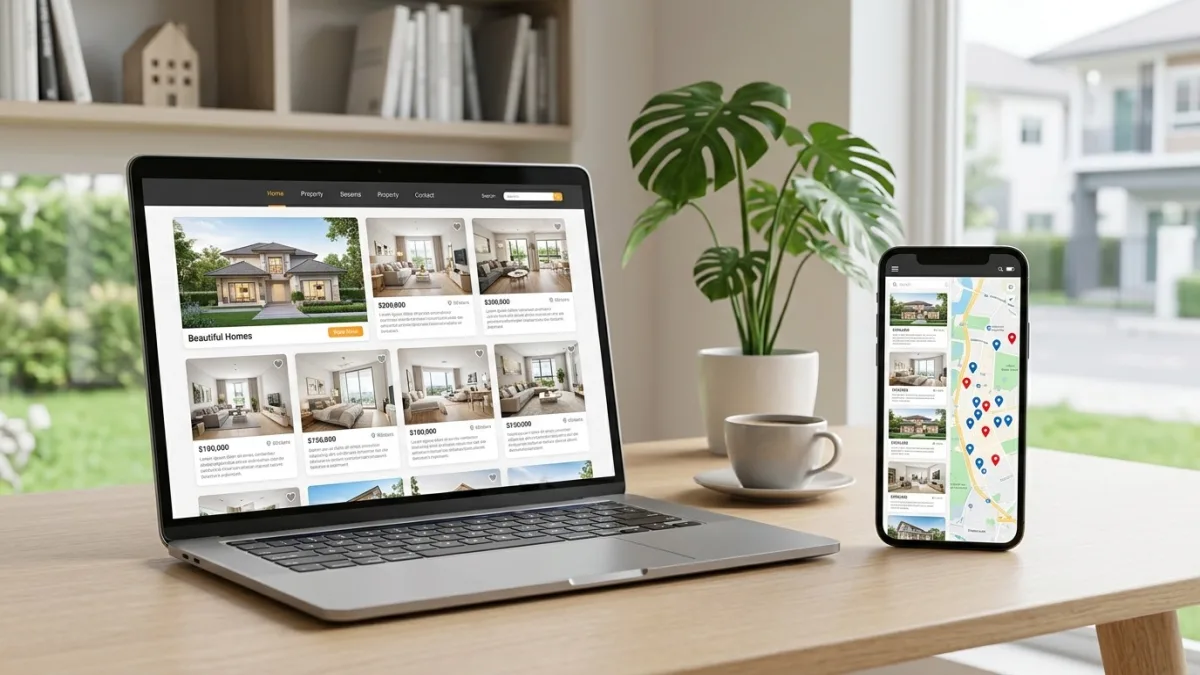
A clear majority of Toronto real estate traffic is mobile — buyers search on the TTC, at open houses, and walking a target street. The make-or-break mobile experience is map-based listing search: pinch-to-zoom on the tile layer, tap targets of at least 44x44 pixels for pins, a thumbnail card on pin tap (photo, price, beds, maintenance fee for condos) without leaving the map, and a filter panel that collapses to a bottom sheet. These are real-estate-specific patterns that generic Google Maps embeds do not provide; most TRREB IDX providers ship a mobile map component that needs clean integration into your visual framework without excessive load weight.
Listing galleries must load fast even on suburban 905 LTE. Serve WebP, lazy-load past the third photo, and use responsive srcset so a phone never downloads a 3 MB desktop image. A condo listing page that renders in under 2.5 seconds keeps the buyer; the same page unoptimized can take 8–12 seconds and lose them before the gallery paints. Lead prompts on mobile should be minimal — a sticky "Contact agent" or "Book a viewing" button in the bottom bar converts at two to three times the rate of a mid-page form, and lead forms should ask for name, email, and phone only. The home valuation form is the one place address capture is unavoidable; use an autocomplete address input to cut friction. The small business website checklist covers the full pre-launch mobile protocol.
Step-by-step: a Toronto realtor website project
Understanding the sequence prevents the schedule failures that push most GTA realtor projects over their original timeline:
- Discovery and TRREB IDX/VOW application (Week 1–2). Define focus (condo, freehold, luxury; buyer, seller, or both), target GTA submarkets and buildings, and competing sites. Submit the TRREB IDX/VOW application to your approved provider immediately — this runs in parallel with design and is the single biggest schedule risk.
- Site architecture (Week 2–3). Map every page type: home, neighbourhood hub, individual neighbourhood and building pages (plan 8–15 at launch), property search, listing detail, about/bio, team directory (if applicable), buyer guide, seller guide, home valuation, blog, and legal pages. Finalize URLs before any design.
- Visual design (Week 3–5). High-fidelity Figma mockups for home, a neighbourhood page, a building page, a listing detail, and the home valuation form — mobile and desktop. Place all RECO/TRESA disclosures (brokerage name, registration, team-name handling) at this stage, not after.
- Build and TRREB integration (Week 5–11). Develop the theme from approved mockups, install and configure the IDX (and VOW, if used) feed against live TRREB data once approved, build building/neighbourhood templates with pre-filtered search, wire the home valuation form to email and CRM, and configure CASL consent on every lead form.
- Content population (parallel, Week 4–11). Original building and neighbourhood content written from genuine GTA knowledge — not an overseas template. Agent bio, headshot, and consented testimonials provided here.
- QA and compliance review (Week 11–13). Cross-browser and mobile testing; verify TRREB attribution on every listing template; RECO/TRESA audit (brokerage name, registration, claim substantiation, team-name compliance); CASL checkbox present and functional; privacy policy referencing PIPEDA live.
- Launch (1–2 days). DNS cutover, SSL active, Search Console verified and sitemap submitted, Google Business Profile updated with the new URL, IndexNow ping sent, and 301 redirects mapped from every old URL if replacing a prior site.
- Post-launch optimization (first 60 days). Monitor Search Console for indexing and crawl issues, review lead conversion (iterate if under 2% of unique visitors submit any form), add heatmapping (Microsoft Clarity is free and PIPEDA-friendly), and plan the next batch of building/neighbourhood pages from the impression data Search Console surfaces within four to six weeks.
Pre-launch checklist for Toronto realtor websites
Use these as explicit acceptance criteria before signing off — each is a regulatory obligation, a lead-generation dependency, or a costly post-launch failure:
- TRREB IDX feed is live and pulling current GTA listings — test against a property you know listed in the last 48 hours
- If using VOW: registration wall functions, sold data displays only to registered users, and terms acceptance is recorded
- Required TRREB board attribution and disclaimer appears on every listing template — verify exact text against your data agreement
- REALTOR® trademark used in correct form wherever it appears
- Registered brokerage name, RECO registration, and salesperson/broker name visible on all pages; team name does not imply an independent brokerage (TRESA)
- Any performance or "we sell faster / for more" claim is substantiable and documented
- Home valuation form captures address, name, email, phone — sends visitor confirmation and agent notification
- Building / neighbourhood pages each have original local content (no templated placeholder), with embedded IDX pre-filtered correctly
- Saved-search / building-alert registration tested end-to-end — sign up, confirm, trigger a matching listing, verify alert lands in inbox not spam
- CASL express-consent checkbox on every email-list form — unchecked by default, with unsubscribe in all outbound mail
- Privacy policy live and referencing PIPEDA; cookie banner fires before analytics or ad pixels load (verify in DevTools network tab)
- Google Business Profile updated with the new URL immediately after DNS cutover
- XML sitemap submitted to Search Console; RealEstateListing schema present on listing pages
- Core Web Vitals on PageSpeed Insights: LCP under 2.5s mobile, CLS under 0.1; condo galleries load under 2.5s on LTE
- Mobile UX tested on a small screen (iPhone SE) and a current Samsung Galaxy
- 301 redirects from every old URL verified in Screaming Frog or Sitebulb if replacing a previous site
Common mistakes Toronto realtors make online
These errors recur across GTA realtor website audits and are nearly all preventable with a competent brief:
One generic city page instead of building and submarket pages. The biggest missed opportunity in Toronto. A single "search Toronto listings" page cannot capture building-name, micro-neighbourhood, or constraint-specific search intent — and that is where the convertible traffic lives. Agents who skip building pages compete only on head terms they cannot win.
Delaying the TRREB IDX/VOW application. Provisioning takes one to three weeks through your provider and TRREB. Requesting it "after the design is done" means launching listing-less, keeping the site live without search for weeks, and wasting the high-authority indexing window right after launch.
Burying the brokerage name behind the team brand. Toronto's strong team branding frequently collides with RECO/TRESA's mandatory, prominent brokerage identification. A beautiful team-branded header with no visible brokerage name is a compliance failure that invites complaints.
Importing US SaaS without CASL handling. Several popular US real estate CRMs do not natively accommodate CASL express consent. A drip campaign to GTA recipients without documented consent is a CASL violation regardless of content, with penalties up to CA$10 million. Configure a CASL-compliant consent layer before collecting a single email.
Generic neighbourhood copy. "Toronto is a vibrant, diverse city" ranks for nothing and signals no expertise. Real ranking content is specific: school feeders, transit lines, building maintenance-fee norms, lot vintages, flood and basement risk by pocket. One genuine 800-word building or neighbourhood guide outperforms ten generic city blurbs.
No home valuation page. In a seven-figure detached market, the home valuation page is the highest-converting seller asset — and the most commonly missing one. Every GTA homeowner has wondered what their property is worth; a three-field valuation page captures them at peak intent and ranks for "[municipality] home value" and "what is my house worth [neighbourhood]."
Case study: a King West condo specialist doubles inbound buyer leads
A downtown Toronto condo specialist (anonymized at the agent's request) came to a redesign in 2024 with a four-year-old WordPress site: a single sitewide "search listings" page, no building-level structure, a weak domain authority, and roughly three inbound web leads per month — all from the contact form. Buyer business came mostly from referrals and the agent's TRREB Realtor.ca profile, despite genuine, deep expertise in King West and CityPlace towers that was nowhere visible on the site.
The approach. Three pillars. First, a TRREB IDX integration (plus a VOW feed for sold comparables) was applied at kickoff — the application was submitted on day one and the feed was live before the redesign finished. Second, ten building landing pages were built for the agent's core towers in King West, the Entertainment District, and CityPlace, each with 700–900 words of original content (developer, completion year, unit mix, amenities, maintenance-fee range, locker/parking, walk-and-transit detail), an embedded IDX search pre-filtered to that building, sold comparables via VOW, and a "notify me when a unit lists here" alert. Third, a home valuation page with a three-field form and a 30-minute follow-up SLA was added for the condo-seller side. Total build: CA$13,400, plus CA$190 per month for the IDX/VOW subscription.
The results. Within 90 days, the site ranked in Google's top five for seven of the ten building-name queries targeted — terms with low competition and high purchase intent. Within six months, inbound web leads averaged eight per month, more than double the pre-project baseline of three, and building-alert registrations were compounding a list of tower-specific buyers. The home valuation page converted at 3.8% of unique visitors and produced two condo seller listings in the first six months. The project recovered its full cost in commission within the first two closings. The agent's Google Business Profile, set up with category "Real Estate Agent" before launch and supported by a steady review cadence, reached the local three-pack for "King West condo agent" within nine weeks — a position held since through consistent reviews and fresh building content.
Frequently asked questions
How much does a real estate website cost in Toronto?
CA$4,000–$7,500 for a configured WordPress-plus-TRREB-IDX build, CA$8,000–$16,000 for a condo or luxury specialist site with map search, building pages, and a home valuation funnel, and CA$28,000–$60,000+ for a brokerage or team portal. Add CA$100–$350 per month for the TRREB IDX/VOW feed through a CREA-approved provider, separate from hosting and maintenance. GTA costs sit slightly above the national average given the competitive condo and luxury segments.
How do Toronto realtors get TRREB MLS listings on their website?
Through TRREB's IDX/VOW data products or the national CREA DDF feed, accessed via an approved provider such as MyRealPage, AgentLocator, IXACT, or RealtyNinja. You need active TRREB and CREA membership in good standing plus brokerage authorization. The provider handles data ingestion, refresh cadence, and required board attribution. Submit the application at project kickoff — provisioning takes one to three weeks.
What is the difference between TRREB IDX and VOW?
IDX displays active listings publicly with no login, powering your site's public search and SEO. VOW requires visitor registration and a brokerage agreement, but unlocks sold prices, listing history, and expired/terminated data. In Toronto, IDX drives organic traffic while VOW powers logged-in sold-comparable experiences that sophisticated GTA buyers expect — many strong sites run both.
What RECO and TRESA rules apply to a Toronto realtor website?
Under TRESA and RECO, every page that is advertising must prominently show the registered brokerage name, the salesperson or broker name as registered, and the fact of registration; team and trade names must not imply an independent brokerage. Performance claims must be substantiable, and TRREB MLS data must carry required attribution. Build these into the design rather than retrofitting them.
Do I need a condo-specific website if I sell Toronto condos?
Strongly recommended. Condos are roughly half of Toronto resale transactions and buyers search by building name, maintenance-fee range, locker/parking, and amenities — not generic city terms. Building-specific landing pages with embedded IDX search filtered to that tower capture this hyper-specific intent and convert well above site average, which generic city pages cannot do.
How long does it take to build a Toronto realtor website?
A WordPress-plus-TRREB-IDX site takes 5–7 weeks; a full condo/luxury agent site with custom design, building and neighbourhood pages, a home valuation funnel, and local SEO foundations takes 9–13 weeks. The TRREB IDX/VOW application adds one to three weeks and must be submitted at kickoff. Original local content is the most common cause of timeline slip, so brief a GTA-literate writer on day one.
Can a Toronto agent rank against Realtor.ca, Zolo and HouseSigma?
Not for broad head terms like "condos for sale Toronto" — the portals own those. What a GTA agent can win is hyper-local and building-level search: a named tower, a "[neighbourhood] condos under $X" query, or seller-intent terms like "what is my Etobicoke home worth." Paired with a strong Google Business Profile and 40-plus genuine reviews, these pages generate transactional leads the portals do not monetize for individual agents.
Get a free Toronto realtor website plan
Tell us your GTA market, your focus (condo, freehold, luxury; buyers, sellers, or both), and your brokerage — we send back a platform recommendation, scope estimate, and a timeline with TRREB IDX/VOW integration accounted for. No payment required.